Sepiolite for Bioplastics (Emerging)
Reinforcing the Future of Sustainable Packaging
As the world moves away from petroleum-based plastics, sepiolite is emerging as a critical reinforcement mineral for bioplastics. Its natural needle-like nano-fibres, when dispersed into PLA, PHA, starch, and other biodegradable polymers, dramatically improve mechanical strength, thermal resistance, and gas barrier properties — solving the performance gaps that have historically limited bioplastic adoption in demanding packaging and product applications.
Why Sepiolite for Bioplastics (Emerging)
Mechanical Reinforcement
Sepiolite nano-fibres (10–30nm diameter, 1–5µm length) act as a natural fibre reinforcement in biopolymer matrices. At just 3–5% loading, tensile strength increases by 30–40% and flexural modulus by 50–70%, bringing bioplastics closer to conventional plastic performance.
Barrier Property Enhancement
Sepiolite's high aspect ratio creates a 'tortuous path' for gas and moisture molecules migrating through the polymer film. This reduces oxygen permeability by 40–60% and water vapour transmission by 30–50% — critical improvements for food packaging shelf life.
Maintained Compostability
Unlike glass fibre or carbon fibre reinforcements, sepiolite is a natural mineral that does not impede composting. Sepiolite-reinforced PLA films meet EN 13432 and ASTM D6400 compostability standards, breaking down completely in industrial composting facilities.
Improved Processability
Sepiolite acts as a nucleating agent in semi-crystalline biopolymers, accelerating crystallisation and shortening cycle times in injection moulding and extrusion. This improves production efficiency and reduces manufacturing costs.
Heat Deflection Temperature
One of PLA's biggest weaknesses is softening above 55°C. Sepiolite nano-reinforcement raises the heat deflection temperature by 10–15°C, enabling applications in hot-fill packaging, automotive interiors, and electronics housings that were previously impossible.
Anti-Microbial Potential
Sepiolite can be loaded with zinc, silver, or copper ions that provide antimicrobial activity in the finished bioplastic. This opens applications in food-contact packaging, medical devices, and hygienic consumer products.
From Mine to Your Application
Nano-Fibre Preparation
Sepiolite is processed to delaminate fibre bundles into individual nano-fibres. This involves controlled high-shear dispersion in aqueous or organic media.
Compatibilisation
For optimal interfacial adhesion, sepiolite surfaces can be modified with silane coupling agents or grafted with polymer chains that are miscible with the target biopolymer matrix.
Masterbatch Production
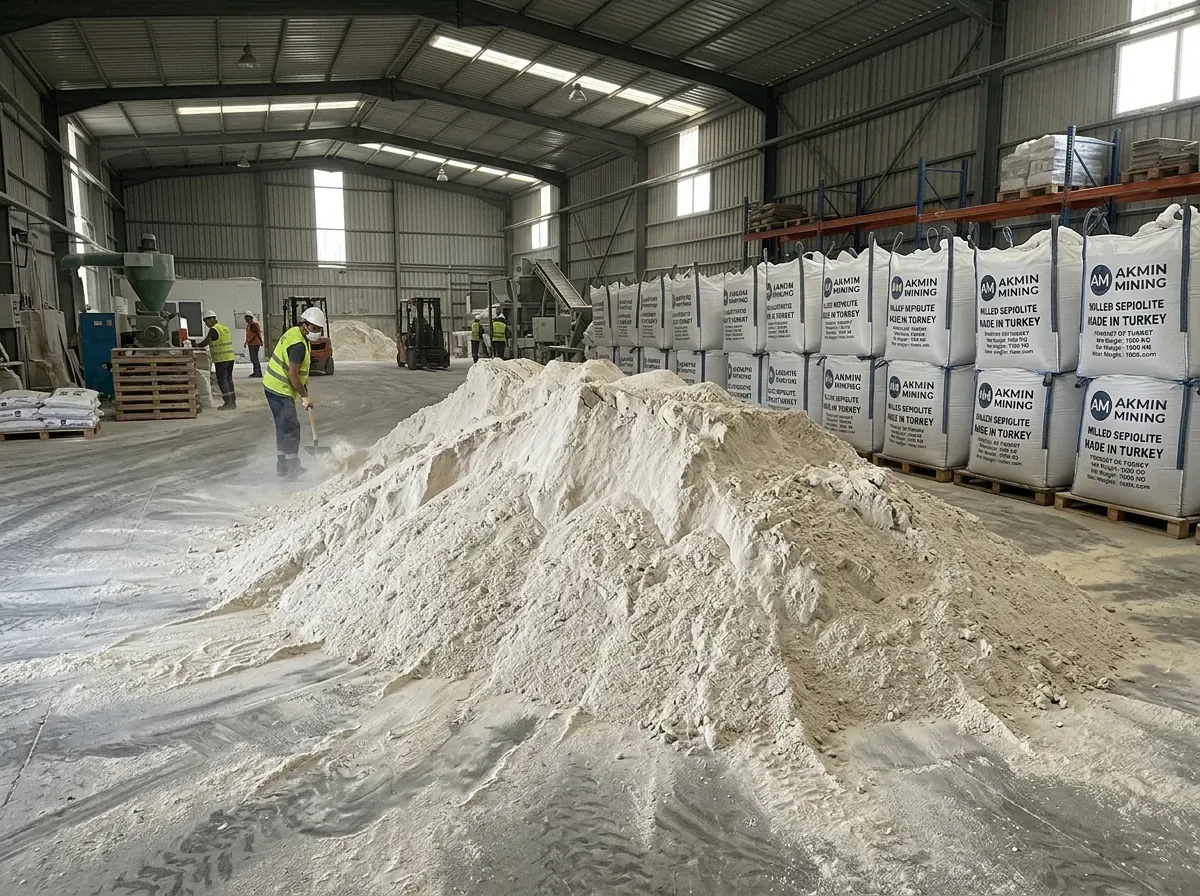
We produce concentrated masterbatches (20–40% sepiolite in PLA or PHA carrier) that can be let-down to the desired final concentration during the customer's moulding or extrusion process.
Application Development
Our polymer laboratory tests mechanical, thermal, barrier, and compostability properties of finished compositions. We provide full data sheets for each development project.
Scale-Up Support
We work with compounders and converters to scale formulations from laboratory to production, providing process parameter guidance and on-site technical support.
Typical Specifications
| Parameter | Value |
|---|---|
| Fibre Diameter | 10–30 nm (individual) |
| Fibre Length | 1–5 µm |
| Surface Area (BET) | 240–350 m²/g |
| Typical Loading | 3–10 wt% in polymer |
| Compatible Polymers | PLA, PHA, PBS, starch, PBAT |
| Compostability | Meets EN 13432 / ASTM D6400 |
| Packaging | 25kg bags / masterbatch pellets |
Frequently Asked Questions
At 5% loading, sepiolite-reinforced PLA reaches tensile strength of 65–70 MPa and flexural modulus of 5–6 GPa — comparable to polypropylene. For applications requiring impact resistance, additional toughening agents (PBAT, epoxidised soybean oil) are typically co-added.
At 3% loading, sepiolite causes a slight haze increase (10–15%) due to light scattering by the nano-fibres. For applications where clarity is critical, we recommend our surface-treated grades which minimise haze to 5–8%. For opaque products, there is no limitation.
Sepiolite-reinforced bioplastics are currently in commercial production for food packaging trays, coffee capsules, and agricultural mulch films in Europe. Several major FMCG companies are qualifying sepiolite-PLA for primary packaging applications launching in 2026–2027.
Sepiolite itself is fully compatible with home composting conditions. However, home compostability depends primarily on the base polymer (PLA requires industrial composting; PHA/PBAT blends can home-compost). We recommend formulation testing to the relevant home composting standard (e.g., NF T51-800, OK Compost HOME).
At typical 5% loading with our masterbatch system, the material cost premium is approximately 8–12% over neat PLA. However, cycle time improvements and potential for thinner walls (due to higher stiffness) can offset or even eliminate this premium in many applications.
Ready to Explore Sepiolite for Your Application?
Our technical team provides samples, specifications, and formulation guidance tailored to your industry needs.