Sepiolite for Paints & Coatings
Rheology Control & Anti-Sagging for Premium Finishes
In the paints and coatings industry, sepiolite serves as a multifunctional additive that controls rheology, prevents settling, provides anti-sag behaviour, and creates matting effects. Its unique needle-like crystal structure builds a three-dimensional network in liquid systems that is easily broken by stirring (shear-thinning) but rapidly rebuilds at rest (thixotropy) — giving formulators precise control over application and appearance properties.
Why Sepiolite for Paints & Coatings
Thixotropic Rheology Control
Sepiolite needles interlock to form a gel network at rest, preventing pigment settling and drip. Under shear (brushing, rolling, spraying), the network breaks apart for smooth application. Recovery is rapid — within seconds the gel reforms, preventing runs and sags.
Anti-Settling Agent
Heavy pigments like titanium dioxide, zinc oxide, and iron oxides tend to settle during storage. Just 0.5–1% sepiolite by weight creates a permanent suspension network that keeps pigments uniformly dispersed throughout the shelf life of the product.
Anti-Sag Performance
On vertical surfaces, paints containing sepiolite resist sagging even at high film thicknesses. This allows single-coat coverage applications that would be impossible with conventional rheology modifiers, reducing labour time and material consumption.
Matting Effect
At dosages of 2–5%, sepiolite creates a natural matte finish by disrupting surface gloss through micro-roughness. Unlike silica matting agents, sepiolite provides simultaneous rheology control and matting in a single additive, simplifying formulations.
Compatible with All Systems
Sepiolite works in water-based, solvent-borne, and high-solids coating systems. It is compatible with all common binder types (acrylics, alkyds, epoxies, polyurethanes) and does not interfere with colorants, biocides, or other functional additives.
Zero VOC Contribution
As an inorganic mineral, sepiolite contributes zero volatile organic compounds to the formulation — supporting compliance with increasingly strict VOC regulations in the coatings industry worldwide.
From Mine to Your Application
Micronisation
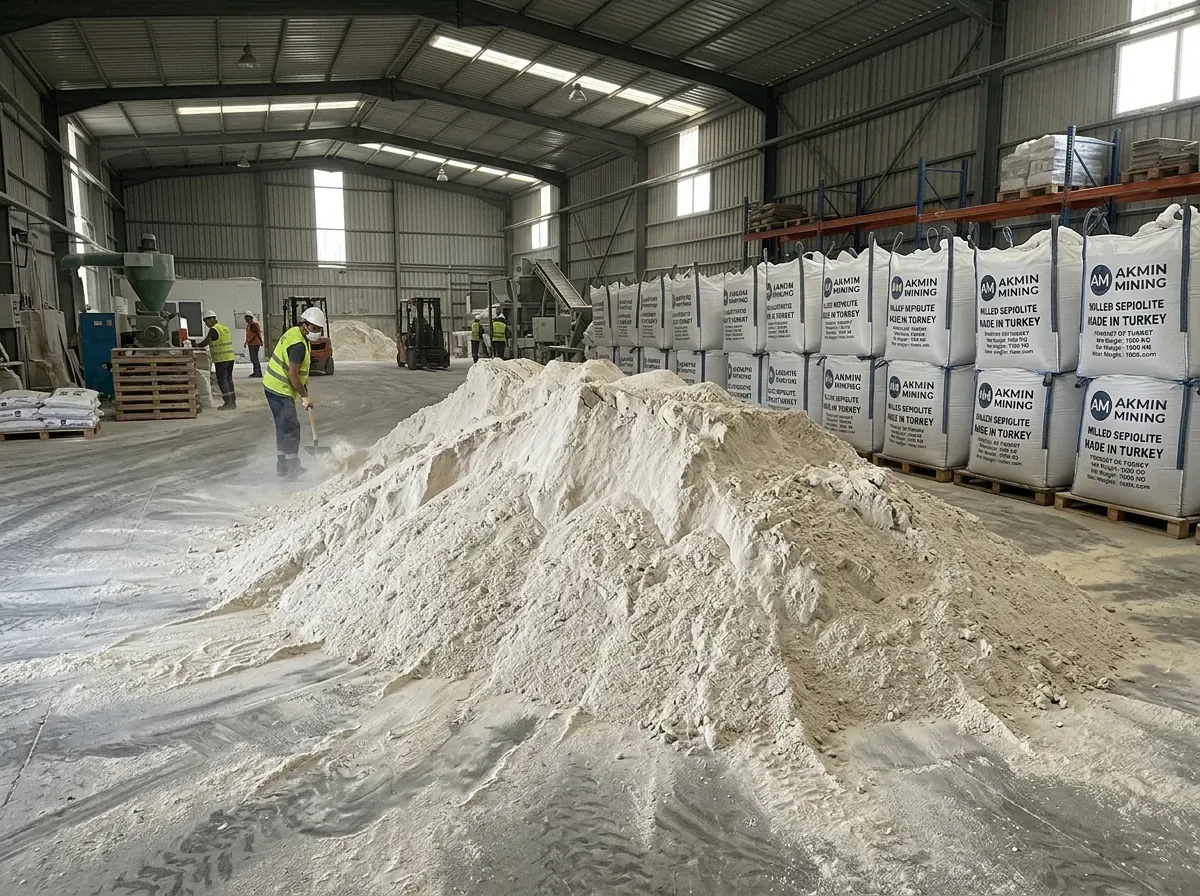
Sepiolite is processed to ultra-fine particle size (<10µm) through jet milling to ensure complete dispersion in liquid coating systems without visible texture.
Surface Treatment (optional)
For solvent-borne systems, sepiolite can be surface-treated with organosilanes to improve compatibility and dispersion in non-polar media.
Pre-Dispersion
For easier incorporation, we offer pre-dispersed sepiolite pastes (50% solids in water or solvent) that can be added directly to the grind or let-down stage.
Technical Formulation
Our coatings laboratory develops application-specific formulations and provides detailed incorporation guidelines for each coating type.
Quality & Consistency
Particle size distribution, moisture, and rheological performance are tested on every batch to ensure batch-to-batch consistency in your production.
Typical Specifications
| Parameter | Value |
|---|---|
| Particle Size (D50) | 4–8 µm |
| Moisture | < 8% |
| pH (10% slurry) | 8.0–9.5 |
| Bulk Density | 0.15–0.25 g/cm³ |
| Oil Absorption | 140–180 g/100g |
| Typical Dosage | 0.5–5% on total formulation |
| Packaging | 25kg bags / 500kg big bags |
Frequently Asked Questions
For best results, add sepiolite during the grinding/dispersion stage with pigments at high shear. If adding at let-down, pre-disperse in a small volume of the binder or use our pre-dispersed paste to ensure full delamination of the needle bundles.
Sepiolite is an off-white to light cream mineral. At typical dosages (0.5–3%), colour impact is minimal in tinted formulations. In pure white paints, it may cause a very slight warm shift that can be compensated with minor tinting adjustments.
Both create thixotropic networks, but through different mechanisms. Fumed silica works through hydrogen bonding (best in polar systems), while sepiolite works through physical entanglement (effective in all systems). Sepiolite is typically 40–60% cheaper per unit of thixotropic effect.
Yes. Sepiolite is transparent to UV radiation and does not inhibit photoinitiator activity. It provides effective anti-settling and sag resistance in UV-curable formulations including inks, overprint varnishes, and wood coatings.
Minimum order is 1 pallet (40 × 25kg bags = 1 tonne). For pre-dispersed paste, minimum is 500kg. Sample quantities of 5–10kg are available for laboratory evaluation.
Ready to Explore Sepiolite for Your Application?
Our technical team provides samples, specifications, and formulation guidance tailored to your industry needs.